
Regenerative agriculture and greenwashing: how to tell the difference

If you’re still unsure exactly what regenerative agriculture is, we recommend starting with the blog post “What Is Regenerative Agriculture?”
This article builds on that foundation to address one of the most significant risks associated with its growing corporate adoption: greenwashing. Because the credibility of the agri-food sector is at stake today at the intersection of regenerative agriculture and greenwashing.
A new model for understanding sustainable agriculture
Over the past few months, I have been observing how the global conversation on regenerative agriculture and sustainability within the agri-food sector has evolved, and how these issues are increasingly influencing investment decisions, corporate strategies, and long-term sourcing models.
More and more companies are incorporating commitments related to sustainable sourcing, emissions reduction, supply chain traceability, promoting biodiversity, and so on.
And this isn’t just about reputation.
The market has begun to understand that the degradation of natural capital is not merely an environmental problem. It also poses operational, financial, and supply risks, and directly translates into a loss of competitiveness.
The World Economic Forum estimates that more than half of global GDP depends moderately or highly on nature and ecosystem services. And among the sectors with the highest exposure is precisely the agri-food sector, whose operations depend directly on variables such as soil health, water availability, pollination, and climate stability.
At the same time, the WEF itself estimates that the transition to “nature-positive” models—which seek not only to protect but also to restore and enhance the natural capital on which agricultural activities depend—could generate more than USD 10 trillion annually in new business opportunities by 2030.
This helps explain why this conversation has moved beyond purely environmental concerns to directly impact corporate strategy, investment, supply chain management, and risk management.
In this context, regenerative agriculture emerges as one of the tools with the greatest potential for the agri-food sector.
How do these risks manifest in global agri-food chains?
As regenerative agriculture gains prominence within corporate strategies and sustainable investments, a significant and increasingly visible risk is also beginning to emerge: that of making vague claims in communications where key indicators are not backed by recognized frameworks—all before the technical and operational capacity necessary to sustain the transformation has actually been built.
This misuse of regenerative agriculture in corporate communications does not necessarily stem from an intention to deceive. It is one thing to build a real productive transformation; it is quite another to communicate it effectively.
Company announcements are based on ambitious goals: Net Zero, regenerative supply chains, deforestation-free sourcing, and all manner of commitments related to positive impacts on nature.
But when those commitments are put into practice, problems often arise: incomplete traceability, non-standardized metrics, limited data availability, regional differences with heterogeneous characteristics, operational complexity, and producers working under vastly different economic realities. All of this makes it extremely difficult to align the expectations communicated from headquarters with what can actually be implemented on the ground.
A concern for consumers and businesses alike
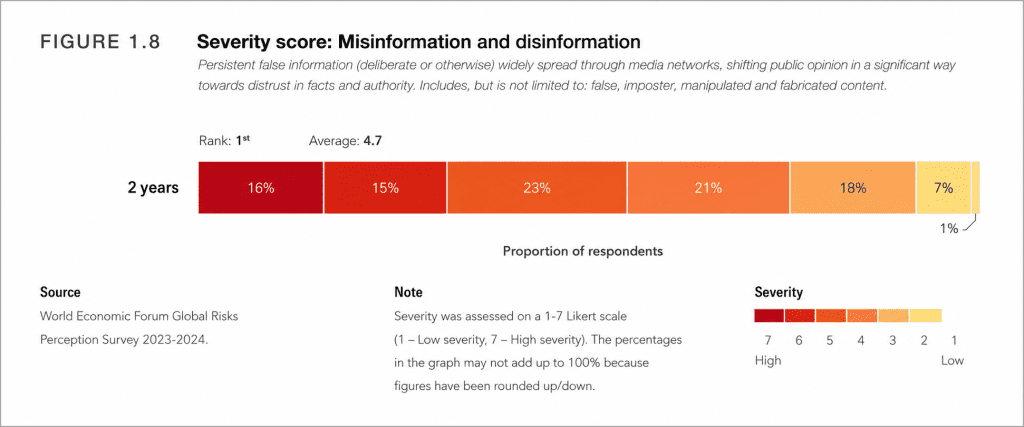
In this context, concerns have been growing about the reliability and quality of published information. This concern has also been identified by the World Economic Forum as one of the main emerging risks.
Global Risks 2024: At a turning point — World Economic Forum
And honestly, I believe this issue deserves a thorough analysis.
Because the debate is generally framed as if there were only two options: committed companies or companies engaging in greenwashing.
But the reality, from my perspective, is usually more complex.
When we talk about greenwashing in food and agribusiness companies, that’s where the real fine line appears: between a legitimate ambition to implement sustainable practices and, on the other hand, communicating their results with too much optimism and too little legitimacy.
And this is why we increasingly need to better understand what greenwashing is and how it works, especially within global agri-food supply chains, where companies must work with a large number of different producers, varying regulatory frameworks, uneven data availability, traceability challenges, and vastly different production contexts across regions.
At the same time, companies face growing pressure from investors, markets, regulations, consumers, and increasingly demanding ESG targets.
The FAO estimates that nearly one-third of the world’s soils show some degree of degradation. This helps explain why the issue has evolved from being merely an environmental problem into an economic and strategic discussion as well.
And when it comes to the market, it is also beginning to demand real evidence. We are seeing increasing demands related to traceability back to the source of raw materials, validation of environmental claims, emissions, biodiversity, and climate risk management.
This is putting pressure on companies to move from general commitments to much more concrete models of implementation and validation.
Regulations such as the EU’s EmpCo Directive or the Green Claims Directive, which require greater technical backing with verifiable evidence for environmental claims, reflect a clear trend: the need to reduce the risk of greenwashing. It is no longer enough to communicate intentions; now it is necessary to demonstrate that the stated impacts are real, measurable, and traceable.
Regenerative agriculture as real transformation
The Role of Specialized Strategic Consulting
Regenerative agriculture cannot be limited to a communication strategy or brand differentiation. We need to transform it into a real operational capability within agri-food chains.
And that is surely one of the greatest challenges we face today in the sector.
Because the problem is no longer just defining what “regenerative” means. The real challenge is how to translate those commitments into measurable, technically scalable, and, above all, economically viable production systems.
In my view, the companies that position themselves best in this transition will not necessarily be the ones that communicate the most or the most eloquently. They will be the ones that manage to integrate sustainability into their operations, their supply chains, their information systems, and their relationships with producers—and if they can communicate that effectively on top of it, all the better.
That is where we can add real value.
The true distinction between regenerative agriculture for real transformation and greenwashing will depend less and less on what companies show, and increasingly on what they are actually capable of measuring and demonstrating.
Author
Juan Legelen Dutra
Agri-Food Sector Consultant
Agricultural engineer specializing in sustainability and the agrifood sector. With experience in regenerative agriculture, responsible sourcing, and sustainable finance, I assist companies in integrating ESG criteria into their growth and competitiveness strategies. I bring a hands-on and entrepreneurial approach, combining agricultural operations, sustainability, and the management of projects with social and environmental impact.


How can we support you?
Do you have any question regarding our services? Let us know! We will be glad to help.